

Keeping high-performing employees at your company is important if you want to build a healthy and sustainable business.
These individuals often drive innovation, enhance team performance, and contribute significantly to the overall success of the organization.
High turnover rates can be costly, both financially and culturally. On the flip side, a high retention rate often signals a healthy, thriving company.
But how do you measure your company’s employee retention rate? And more importantly, how can you improve it, especially if you’re leading a small team?
In this article, we’ll guide you through the process of employee retention rate calculation. We’ll also share practical strategies to boost your retention rates.
Understanding Employee Retention Rates
Simply put, it’s the percentage of employees that stay with your company over a given period.
But it’s more than just a number. It’s a reflection of your company’s health. A high retention rate often indicates a positive work environment, competitive compensation, and effective management.
On the other hand, a low retention rate can signal problems. These could range from poor management practices to inadequate benefits or lack of growth opportunities.
In essence, your employee retention rate is a key indicator of your company’s ability to keep its talent. And in today’s competitive job market, that’s crucial.
Why Employee Retention Matters
Employee retention is more than just keeping your staff numbers up. It’s about maintaining the knowledge, skills, and experience within your company.
When employees stay, they continue to build their skills and knowledge. This leads to increased productivity and better service for your customers.
Moreover, high retention rates can boost your company’s reputation. It sends a message to potential employees that your company is a great place to work.
The Cost of Employee Turnover
On the flip side, losing employees can be costly. And we’re not just talking about recruitment and training costs.
When an employee leaves, their knowledge and skills leave with them. This can lead to a decrease in productivity and service quality.
Moreover, high turnover can negatively impact your company’s culture. It can lower morale and lead to further turnover. In short, it’s a cycle you want to avoid.
How to Calculate Employee Retention Rates
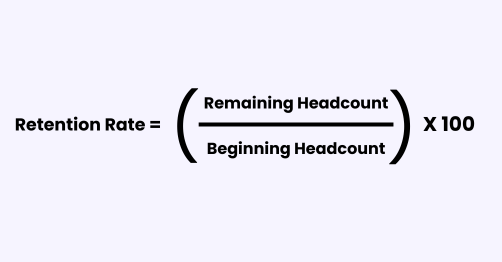
The formula for calculating employee retention rate is quite straightforward. You divide the number of employees who stayed with your company by the number of employees at the start of the period. Then, multiply the result by 100 to get a percentage.
Here’s what it looks like:
Step-by-Step Guide to Calculating Retention Rate
- Start by determining the period for which you want to calculate the retention rate. This could be a month, a quarter, a year, or any other period that makes sense for your business.
- Next, figure out the number of employees at the start of the period. This is your starting point.
- Then, determine the number of employees who stayed with your company throughout the entire period. These are the employees who were there at the start and are still there at the end.
- Now, divide the number of employees who stayed by the number of employees at the start. This will give you a decimal.
- Finally, multiply the decimal by 100 to convert it into a percentage. This is your employee retention rate.
Say you wanted to measure your employee retention rate for the previous month. On the first day of the month, you had 50 employees, and on the last day of the month you had 48 employees, so 2 team members left your company.
Your employee retention rate would look like: (48/50) x 100 or 96%
Interpreting Your Retention Rate
So, you’ve calculated your retention rate. But what does it mean?
A high retention rate is generally a good sign. It suggests that your employees are satisfied and see a future with your company.
On the other hand, a low retention rate could indicate problems. These might include poor management, lack of growth opportunities, or inadequate compensation.
Remember, though, that context is key. Industry norms, company size, and other factors can influence what’s considered a “good” or “bad” retention rate. It’s important to benchmark your rate against similar companies to get a true sense of where you stand.
Retention Metrics and Retention Analysis
Retention metrics are more than just numbers. They’re powerful tools that can guide your HR strategy.
By tracking key metrics, you can identify trends and patterns. This can help you understand what’s working and what’s not in your retention efforts.
Moreover, retention metrics can provide insights into employee satisfaction and engagement. This can help you make informed decisions to improve these areas.
Key Retention Metrics to Track
There are several retention metrics that can provide valuable insights.
First, there’s the overall retention rate. This gives you a broad view of how well you’re keeping employees.
Next, consider tracking retention rates for specific groups. This could be by department, role, or demographic. This can help you identify any disparities or issues within these groups.
Finally, don’t forget about turnover rate. This is the flip side of retention and can provide additional insights into your workforce dynamics.
How Retention Analysis Can Drive Better Decisions
Retention analysis is about making sense of your metrics. It’s about digging deeper to understand the “why” behind the numbers.
For example, if you notice a high turnover rate in a particular department, don’t stop there. Investigate further. Are there issues with management? Is the workload too high? Are there not enough growth opportunities?
By understanding the root causes, you can make targeted changes. This can lead to more effective retention strategies and, ultimately, a happier, more engaged workforce.
Leveraging Digital Platforms to Enhance Retention
In today’s digital age, technology can be a game-changer in managing employee benefits and improving retention.
Digital platforms can simplify benefits administration, making it easier for both HR and employees. They can also provide valuable data for retention analysis.
Digital benefits platforms can play a crucial role in employee retention. They can make benefits more accessible and easy for employees to understand.
Solutions such as LIVD – a mobile app for employee fringe benefits – make this process easy for HR teams and employees. Built with personalization in mind, LIVD allows employees to pick and choose which fringe benefits they want and how they want to be rewarded and recognized. By allowing for flexibility of benefits, this increases employee engagement and satisfaction, leading to higher retention rates.
Practical Strategies to Improve Employee Retention
Improving employee retention requires a strategic approach. It’s not just about offering competitive benefits, but also about creating a positive work environment.
Retention strategies should be tailored to your workforce. They should address the specific needs and preferences of your employees.
Moreover, these strategies should be integrated into your overall business strategy. This can ensure alignment with your company’s goals and objectives.
Tip #1 – Personalizing Benefits to Increase Employee Engagement
Personalizing benefits can be a powerful way to increase employee engagement. It shows that you value your employees as individuals, not just as a workforce.
This can involve offering a range of benefits options. Employees can then choose the ones that best meet their needs.
Digital benefits platforms like LIVD can facilitate this personalization. They can allow employees to easily manage their benefits, increasing engagement and satisfaction.
Tip #2 – Creating a Culture of Recognition and Continuous Development
Creating a culture of recognition can boost employee morale and motivation. It can make employees feel valued and appreciated, increasing their loyalty to your company.
Continuous development is also crucial. It shows that you are invested in your employees’ growth and success.
This can involve offering training and development opportunities. It can also involve providing regular feedback and performance reviews.
Tip #3 – The Importance of Work-Life Balance and Competitive Compensation
Work-life balance is increasingly important to employees. Offering flexible working arrangements can show that you respect your employees’ personal lives.
Competitive compensation is also key. It can demonstrate that you value your employees’ contributions to your company.
Moreover, compensation should be transparent and fair. This can build trust and goodwill, further enhancing employee retention.
The Value of Employee Retention
Employee retention is not just an HR issue, but a strategic business priority. High retention rates can lead to increased productivity, improved morale, and a stronger company culture.
By leveraging digital platforms, personalizing benefits, and fostering a culture of recognition and development, you can significantly improve your retention rates. Remember, your employees are your most valuable asset. Investing in their satisfaction and retention is an investment in the success of your business.
If you want to boost your organization’s benefits package, contact us to learn which personalized employee benefits you can leverage to improve your overall retention.