

Your best employee just turned down a promotion.
Not because they didn’t want more responsibility. Not because the money wasn’t right.
Because they don’t feel valued.
“I work hard,” they told you. “But I never really know if it matters.”
Recognition isn’t a nice-to-have. It’s not about pizza parties or generic “employee of the month” plaques.
Recognition is how people know their work matters. And when it’s missing, even your best people start looking elsewhere.
If you want to build a culture where people stay, contribute, and actually care — recognition has to be at the center.
Here’s how to build a recognition-first workplace that drives real retention, engagement, and performance.
What “Recognition-First” Actually Means
A recognition-first culture isn’t about recognizing more. It’s about recognizing better.
It means:
- Recognition is woven into how your team operates — not something HR schedules quarterly
- Employees feel seen for their contributions, not just their metrics
- Appreciation is specific, timely, and meaningful
- Recognition happens peer-to-peer, not just top-down
Most importantly, recognition-first cultures understand that people don’t leave jobs. They leave feelings.
And the feeling of being invisible, unappreciated, or replaceable? That’s what drives turnover.
Why Most Recognition Programs Fail
Let’s be honest. Most companies have tried recognition programs. And most of them fizzle out.
Here’s why:
They’re performative, not genuine. Scheduled shout-outs in all-hands meetings feel forced. Employees can tell when recognition is checking a box instead of expressing real appreciation.
They’re generic. “Great job this quarter!” doesn’t land. Employees need to hear what they did and why it mattered.
They’re inconsistent. Recognition happens during performance reviews or company-wide events — then disappears for months. By the time the next moment comes, the impact is gone.
They’re one-directional. Managers recognize employees, but peers can’t recognize each other. This creates a hierarchy of appreciation instead of a culture of it.
They’re disconnected from real rewards. A thank-you is nice. But when recognition never translates into something tangible, it starts to feel hollow.
The result? Employees tune out. And HR gets stuck managing programs that don’t actually improve culture.
The 5 Pillars of a Recognition-First Culture
Building a recognition-first culture doesn’t require massive budgets or complex programs. It requires intention.
Here are the five pillars that make recognition stick.
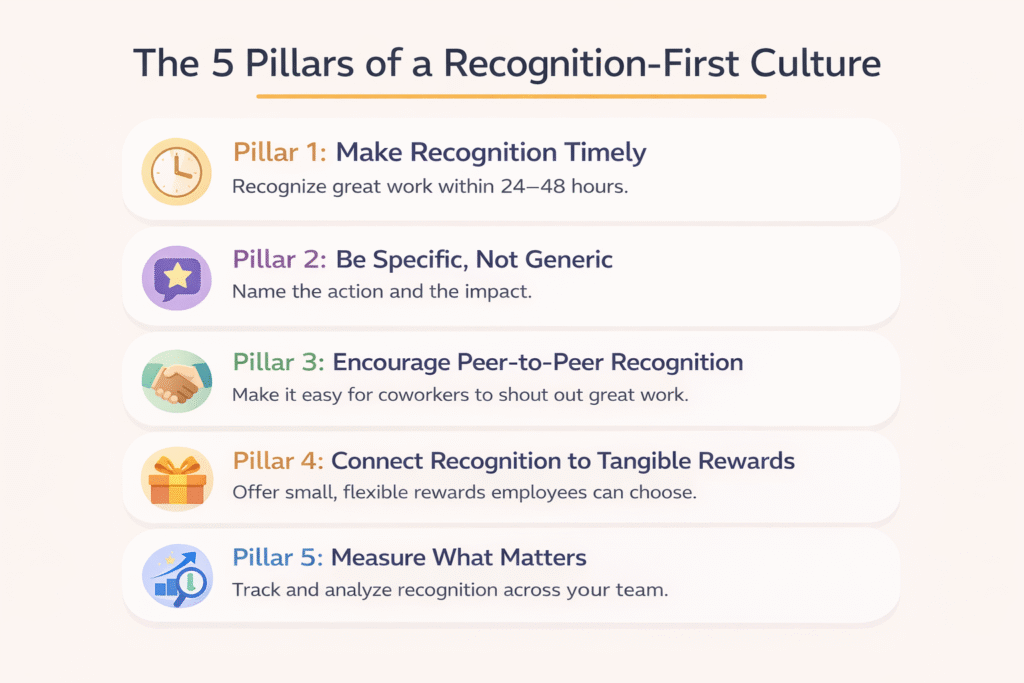
Pillar 1: Make Recognition Timely
Recognition loses power when it’s delayed.
If someone does great work on Monday and you recognize them on Friday, the moment has passed. If you wait until their annual review, it’s almost meaningless.
The rule: recognize within 24–48 hours whenever possible.
This doesn’t mean formal recognition. It can be as simple as:
- A message in Slack: “That presentation was excellent — the way you handled the Q&A was especially impressive.”
- A quick verbal acknowledgment: “I saw how you helped Sarah get unstuck yesterday. That made a real difference.”
Timely recognition reinforces the behavior you want to see more of — while it’s still fresh.
Pillar 2: Be Specific, Not Generic
Generic recognition is forgettable.
“Great work!” doesn’t tell someone what they did well or why it mattered.
Effective recognition names the action and the impact:
- ❌ “Thanks for your hard work this week.”
- ✅ “The way you stepped in to help with the client issue on Tuesday probably saved that relationship. Your ability to stay calm under pressure is exactly what we needed.”
Specificity shows that you’re paying attention. And that’s what makes recognition feel real.
Pillar 3: Encourage Peer-to-Peer Recognition
Recognition shouldn’t only flow from managers to employees.
When peers recognize each other, it:
- Builds team cohesion
- Creates a culture of appreciation that doesn’t depend on management
- Surfaces contributions that managers might miss
How to enable peer-to-peer recognition:
- Create a dedicated Slack channel where employees can shout out colleagues
- Include peer recognition moments in team meetings
- Build recognition into collaborative workflows (e.g., end-of-sprint retrospectives)
The more recognition becomes a team habit — not just a management responsibility — the stronger your culture becomes.
Pillar 4: Connect Recognition to Tangible Rewards
Words matter. But they’re not enough.
When recognition never translates into something tangible, employees start to wonder if their contributions actually matter.
This doesn’t mean you need elaborate bonus structures. Small, flexible rewards can carry significant weight:
- A $50 stipend to celebrate a big win
- An extra day off after a tough project wraps
- Access to a learning opportunity or professional development resource
The key is flexibility. Different employees value different things. One person wants time off. Another wants to invest in a course. A third just wants help covering groceries that week.
When recognition includes a meaningful reward that employees can personalize, it lands differently.
This is where flexible lifestyle benefits shine. Instead of guessing what someone values, you give them the freedom to choose — and recognition becomes both personal and practical.
Pillar 5: Measure What Matters
You can’t improve what you don’t measure.
Recognition-first cultures track:
- Frequency: How often is recognition happening?
- Participation: Are managers and peers both contributing?
- Distribution: Is recognition concentrated on a few people, or spread across the team?
- Impact: Are recognized employees staying longer? Performing better? Reporting higher satisfaction?
You don’t need complex analytics. Simple pulse surveys and retention data tell you whether recognition is working.
If recognition is happening but retention isn’t improving, your recognition isn’t meaningful enough. If only managers are recognizing people, you haven’t built a peer-driven culture yet.
Measurement keeps recognition intentional.
How to Build This in Practice (Step-by-Step)
Turning these pillars into reality doesn’t require starting from scratch. Here’s how to implement recognition that actually sticks.
Step 1: Start Small and Build Momentum
Don’t roll out a full recognition program overnight.
Start with:
- Week 1: Managers commit to recognizing at least one person per week with specific, timely feedback.
- Week 2: Open a peer recognition channel in Slack or Teams.
- Week 3: Introduce a small recognition reward (e.g., $25 flexible stipend for standout contributions).
Small wins build belief. Once the team sees recognition happening consistently, they’ll participate more.
Step 2: Train Managers on Effective Recognition
Most managers want to recognize their teams. They just don’t know how to do it well.
Provide simple training on:
- How to make recognition specific (what they did + why it mattered)
- When to recognize publicly vs. privately
- How to tie recognition to company values
This doesn’t need to be a formal course. A 30-minute workshop or a one-page guide works.
Step 3: Make Peer Recognition Easy
Remove friction from peer recognition.
If employees have to fill out a form or go through HR to recognize a colleague, they won’t do it.
Make it as easy as:
- Posting in a Slack channel
- Sending a quick message with a recognition tag
- Mentioning someone in a team meeting
The lower the barrier, the more it happens.
Step 4: Connect Recognition to Flexible Rewards
Here’s where recognition becomes truly powerful.
When employees are recognized, give them a way to translate that appreciation into something meaningful for their life.
You can offer:
- Flexible lifestyle benefits they can use for wellness, learning, family support, or everyday needs
- The ability to save up recognition rewards for larger purchases
- Choice in how they redeem — because what matters to one person won’t matter to another
Platforms like LIVD make this seamless. Recognition becomes both emotional (you’re appreciated) and practical (here’s something that improves your life).
Step 5: Reinforce and Iterate
Recognition-first cultures don’t happen overnight. They require reinforcement.
- Monthly: Share recognition stats with leadership (how many people were recognized, by whom, for what)
- Quarterly: Survey employees on whether they feel recognized and valued
- Annually: Review retention and engagement data to assess impact
Adjust based on what you learn. If certain teams aren’t participating, dig into why. If recognition isn’t translating to retention, revisit how meaningful your rewards are.
Recognition is a practice, not a program.
What This Looks Like When It Works
Here’s what recognition-first cultures feel like:
- Employees know their work matters because they hear it regularly — not just at review time
- Managers don’t carry the full weight of recognition; peers celebrate each other’s wins
- Recognition isn’t generic; it’s specific to what people actually did
- Appreciation translates into tangible support that fits employees’ lives
- People stay longer, refer friends, and talk positively about the culture
And here’s what HR experiences:
- Less time managing disengaged employees
- Lower turnover and higher retention
- Clearer alignment between company values and daily behavior
- A culture that feels intentional, not accidental
Recognition becomes the thread that holds everything together.
Why LIVD Makes Recognition-First Cultures Easier
Building a recognition-first culture requires the right tools.
LIVD makes it simple by connecting recognition to flexible lifestyle benefits:
- Employees choose how to use their recognition rewards — across 15+ lifestyle categories
- HR gets visibility into recognition patterns — without micromanaging every interaction
- Recognition feels personal — because employees decide what matters most to them
When recognition leads to real support, it stops feeling performative and starts feeling genuine.
The Bottom Line
Recognition isn’t a program you launch. It’s a culture you build.
And culture is built one moment at a time — one specific acknowledgment, one peer shout-out, one meaningful reward that shows someone their work matters.
When you put recognition at the center of how your team operates:
- People feel seen
- Engagement rises
- Retention improves
- And your culture becomes something employees want to protect
The companies that get this right don’t just keep their best people. They attract more of them.
Ready to build a recognition-first culture? Start with the right tools.